
DuPage Resident Records by Name
No single roll is a complete list of DuPage County residents. Each source confirms a narrow fact tied to its own date. The property system names an owner or billing party, not an occupant. A voter match confirms registration details for the person who supplies the required identifiers. A court result identifies a party in a filed matter. Vital indexes point to an event, while certificates remain subject to identity and eligibility rules.
| Record | What It Confirms | Official Keeper | Access |
|---|---|---|---|
| Property | Owner, situs, billing name, PIN, tax year | Supervisor of Assessments | Web, map, county office |
| Voter lookup | Status, precinct, polling place, districts | Election Division | Secure name or address search |
| Court docket | Party, case number, dates, events, status | Circuit Clerk | ePay, eAccess, terminal, copies |
| Vital record | Birth, death, marriage, dissolution event | County Clerk, Circuit Clerk, IDPH | Index or eligible copy |
| License or entity | Credential or official affiliation | IDFPR or Secretary of State | Web index and certification |
Choose the record that fits the question. For a parcel owner, use the Assessor and Recorder. For a case party, use the Circuit Clerk. For a credential, use the state licensing source. This disciplined resident lookup is stronger than a compiled profile whose sources and update dates are unclear.
DuPage Court Name Lookup
The DuPage Circuit Clerk ePay search offers three routes: complaint number with arresting agency, case number, or case name. The name route displays last, first, and middle-name fields, birth date, and a person-or-organization choice. A result may show case number, title, filing date, next court date and place, case events, count descriptions, status, and balance. Those fields describe a docket, not a present home address or a finding about identity.
| Search field | How to use it |
|---|---|
| Full name | Keep the spelling and middle name shown in the source. |
| Birth date | Separates common names when lawfully known. |
| Person / Organization | Prevents a company from being treated as a person. |
| Case or complaint number | Returns to the exact matter after the name search. |
When the page fails or more detail is needed, use a public terminal at 505 N. County Farm Road in Wheaton, call Civil at 630-407-8700 or Criminal/Traffic at 630-407-8600, or request copies. Approved parties may use credentialed eAccess. Sealed, impounded, expunged, juvenile, adoption, and other restricted matters do not appear like ordinary public files.
Verify DuPage Resident Matches
Common names require a method, not a guess. A sound DuPage County resident lookup keeps every record in its own context, then compares stable details. A billing address may differ from the situs, which is where a parcel physically sits. A court name may be a plaintiff, defendant, heir, or business. Even a license city is only the place stated in that credential record.
- Write down the full name, variants, known town, and a date range.
- Anchor the name to a parcel or lawful voter match and note the source date.
- Search the court index with the middle name and birth date when known.
- Compare a vital index, license, obituary, or entity filing without merging near matches.
- Order a certified copy from the custodian only when proof is required.
- Docket
- The court's dated list of filings and events in one case.
- Index versus image
- An index is a finding aid. An image is the filed document and may have separate rules.
- Certified copy
- A copy authenticated by the office that keeps the original.
Confirming DuPage Voter Details
The DuPage Election Division lookup is a secure verification tool, not a downloadable directory. The name path uses last name, date of birth, and either the last four digits of a Social Security number or a driver-license number. Use those identifiers only when the person has supplied them for a lawful search. The address path separates house number, street name, direction, suffix, and city.
A match can return registration status, precinct, polling place, sample ballot, vote-by-mail status, districts, representatives, and contact information. It does not reveal ballot choices. Full voter data follows separate Illinois election-law restrictions, and registration cards have inspection limits near an election. If the tool cannot answer a proper request, contact the Election Division or use its current department FOIA form.
DuPage Vital Record Routes
Resident lookup work often reaches a birth, marriage, death, or divorce, but the keeper changes. The DuPage County Clerk issues qualifying local birth, death, and marriage copies. IDPH provides statewide birth and death copies and verifies marriage and dissolution facts from its 1962-present indexes. A certified marriage copy comes from the county clerk where the license was recorded. A divorce decree comes from the Circuit Clerk.
Current certificates are not open name-search reports. Illinois requires eligibility, identification, a form, and the stated fee. Older genealogy routes are broader: birth records reach genealogical access at 75 years, death records after 20 years, and pre-1916 events may need county, church, cemetery, newspaper, library, or Archives research. The Wheaton Vital Records Index searches newspaper birth, marriage, and death notices from 1889 through 1893. It can turn a name into an event, paper date, page, column, and microfilm trail, but remains a finding aid to verify.
DuPage License and Affiliation Clues
Some searches seek a current credential or dated public affiliation, not a residence. The Illinois Department of Financial and Professional Regulation lookup accepts an individual or entity name, license number, and profession. A result may show license number, type, city, state, ZIP, status, effective and expiration dates, discipline, and other licenses. It does not disclose a private home address, email, or phone.
Open the official IDFPR license lookup before reviewing its fields and profession filter.
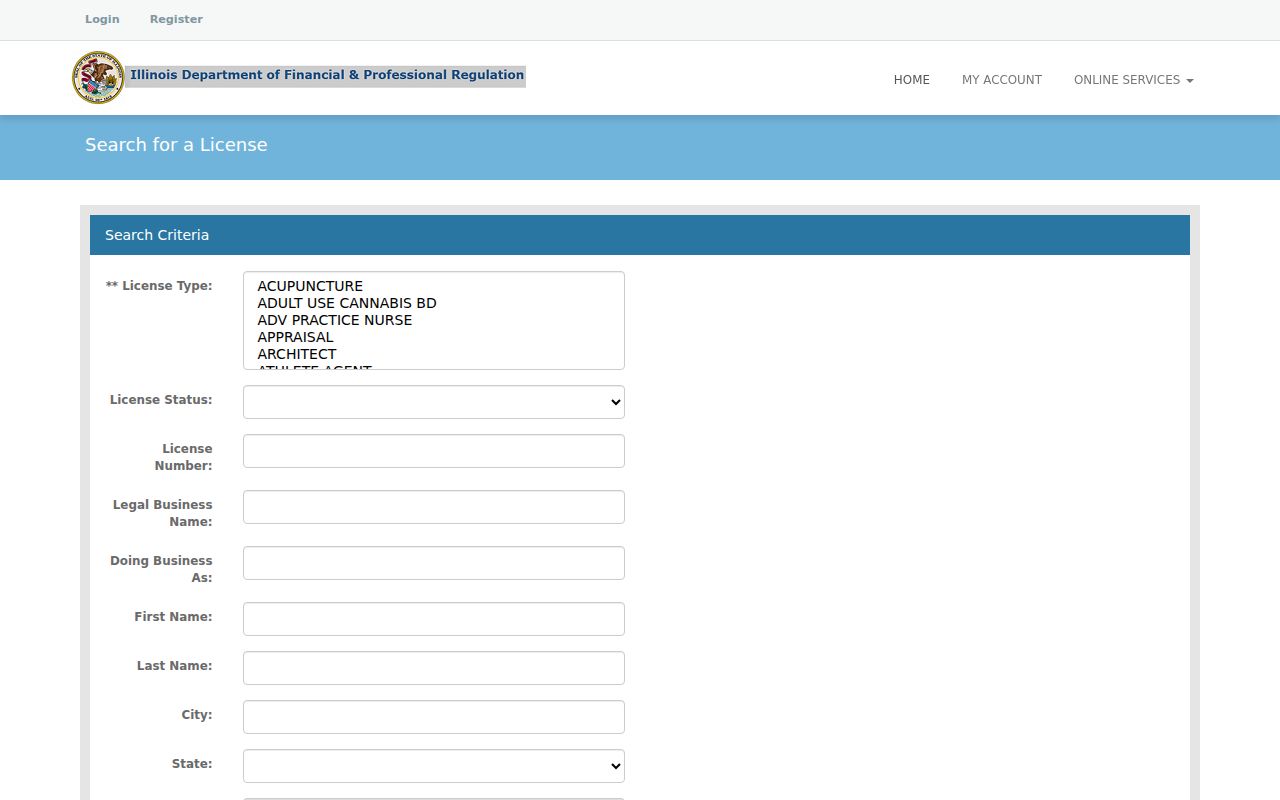
The screen shows why profession and license number can separate two similar names. Save the result date because status changes. DuPage's Economic Interest portal also reports more than 5,000 employees and elected officials, with filer, agency, year, question, report, and CSV routes. It is an ethics disclosure source, not a residence list.
Finding a Specific DuPage Person
An heir search can move from an obituary to a probate docket and then to a deed. Each step answers a different question. A former classmate may be easier to identify in Wheaton or Naperville yearbooks before a current official index is checked. An adopted person or qualifying relative should use Illinois's official registry and confidential-intermediary routes, never try to bypass sealed adoption files.
The Illinois Treasurer's I-CASH name search is another cautious lead for a person or business name.
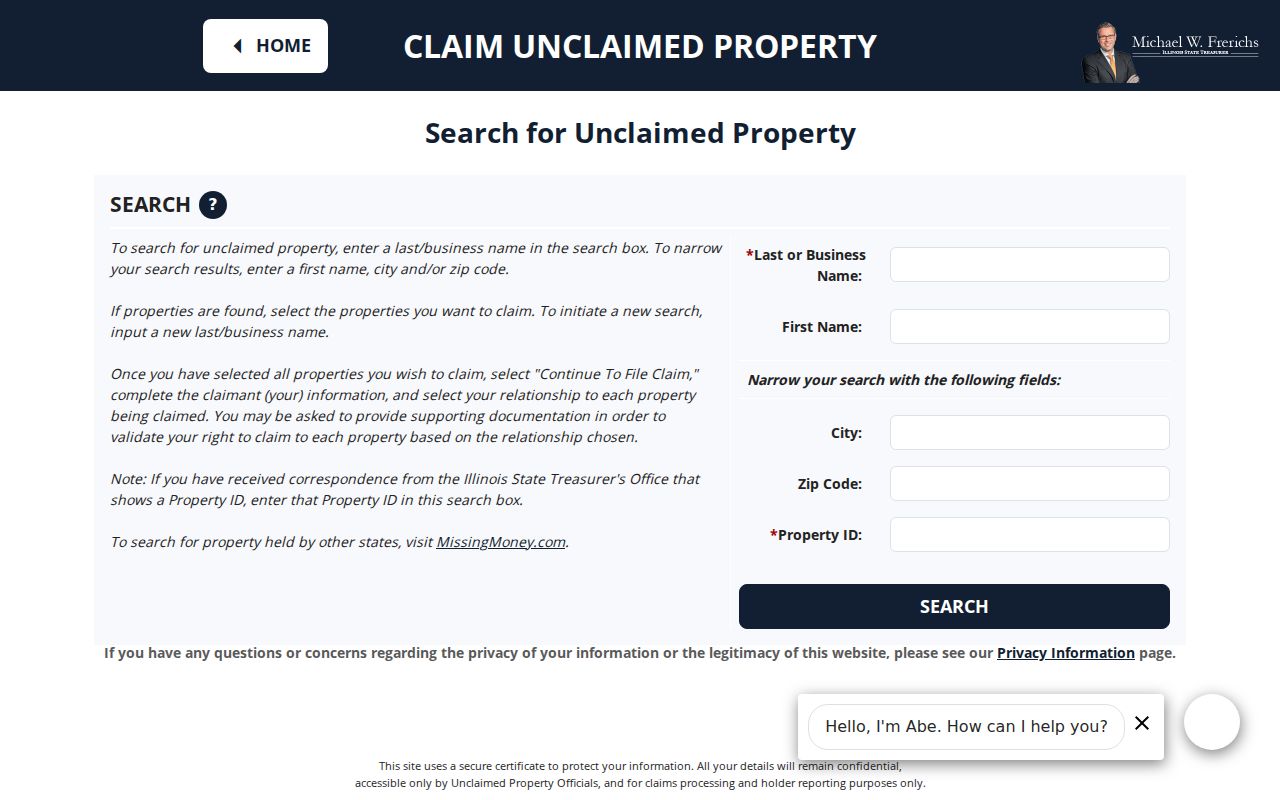
An I-CASH match points to property held by the state. It does not prove current residence, and a claim requires the Treasurer's identity process. Secretary of State entity, UCC, notary, and DuPage assumed-name records can add a dated filing link, but a registered agent or signer is not automatically a current resident.
Protected DuPage Resident Records
Some records are hidden by design. Illinois's Address Confidentiality Program gives eligible survivors a substitute address and mail forwarding, generally for four years. Agencies must accept that address in covered dealings. The program does not erase old deeds, news, court records, or directories, and it does not make a property record confidential.
The Illinois State Police registry has its own agreement and legal-use notice. Review the official registry terms before using it.
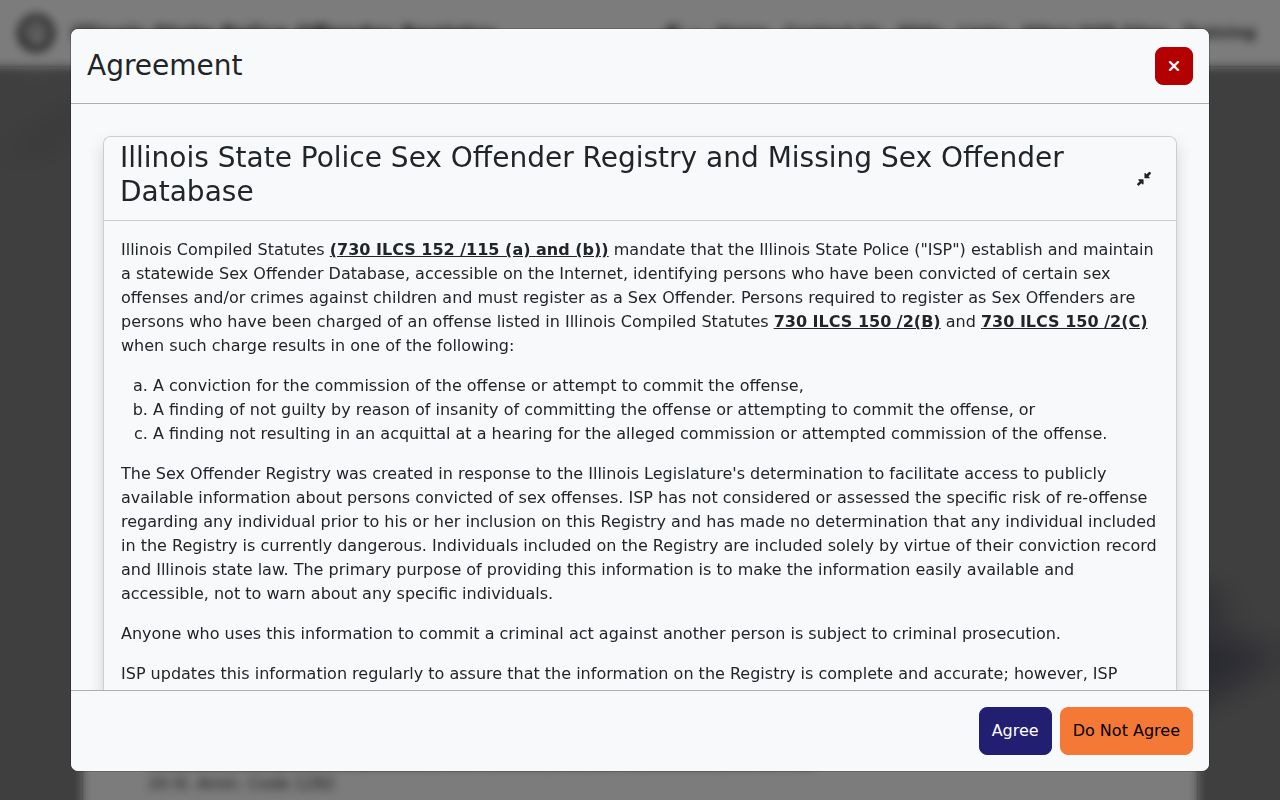
The warning reinforces a broad rule: each official search has a defined scope and cannot be used to threaten, intimidate, or harass someone.
DuPage Resident Lookup Fallbacks
Portal trouble is common. The property site was in maintenance during research, court results depend on JavaScript or credentials, and some County Clerk searches stop at a disclaimer. Do not replace a failed official route with an unsupported claim. Use the channel that preserves the record.
- Visit or call the Circuit Clerk and use a courthouse terminal.
- Send the County Clerk the correct vital form with ID and eligibility proof.
- Ask a library or museum specialist for directories, notices, and archive files.
- File a focused Illinois FOIA request with the department keeping an administrative record.
DuPage FOIA requests normally receive a response within five business days, subject to statutory extensions. Describe the record, dates, office, and names. FOIA is not a way around sealed court files or restricted certificates.
Lawful DuPage Lookup Limits
A name match is a lead, not permission to contact, expose, or pressure a person. Correct errors with the original custodian using a PIN, document number, case number, or index citation. Removing a commercial profile does not remove the official record beneath it. Illinois had no broad enacted data-broker deletion law at the research cutoff; pending bills were not current rights.
Lawful use. Use a DuPage County resident lookup for lawful personal research, and never stalk, harass, intimidate, or harm anyone.
Stop when a protected program, sealed file, identity rule, or statute says to stop. Good verification preserves the source, its date, and what it truly says.