
DuPage Previous Residents by Era
No single source names every person connected with a DuPage County address. A parcel card identifies the current legal owner and may show sales. A deed names parties to a recorded transfer, not everyone in the household. Reverse directories and phone books can supply a listed occupant, while census schedules place a household in a specific enumeration. The best source therefore depends on the date and whether the question concerns ownership, occupancy, or the building itself.
| Source | Years It Covers | Where Held | What It Shows |
|---|---|---|---|
| Recorder deed index | Online name and images from 1961; office books from 1839 | Recorder Online Document Search | Grantors, grantees, document dates, PINs and legal descriptions |
| Haines criss-cross directories | 1988-2021 and 2004-2021 runs | Wheaton Public Library | Published occupant or phone lead by address |
| City and county directories | 1915-16, 1924-25, 1940, 1950 and 1999 examples | Library, museum and digitized copies | Names, spouses, work, address and telephone clues |
| Federal and state census | Selected local schedules through the latest public federal census | Library print, microfilm and databases | Household members and relationships for a census date |
| Maps and real-estate files | Municipality and collection specific | Library of Congress and DuPage County Historical Museum | Building form, lot context, maps, plats and sale files |
For a recent transfer, start with the assessor and Recorder. For a late twentieth-century occupant, move to a Haines volume or phone book. Earlier searches rely more on printed directories, census schedules, plats, Sanborn maps, and museum files. Always record the source year. A name in a 1950 volume says nothing by itself about 1951.
Anchor a DuPage Address
Begin at the DuPage Property Records Search. Search the street address, open the parcel card, and save the PIN, situs address, current tax year, subdivision, and legal description. Situs means the physical property address. The billing or mailing address belongs to the tax account and can be elsewhere, so it is not proof that the owner lives at the parcel.
The PIN and legal description are more durable than a street label. They let a researcher follow a lot when a municipality changes an address, a parcel splits, or an old directory uses a different postal place. The property portal also provides map and neighborhood actions, but its last-certified-date warning matters. Treat the card as a dated starting point, not a live household roster.
Keep the keys together. Save the exact address spelling, PIN, legal description, tax year, and source date before searching for previous residents.
DuPage Deed Search Eras
The DuPage Recorder has unusually clear access cutoffs. Office property records extend from 1839 to the present, while the public name index and digital images begin March 16, 1961. PIN search reaches 1985 forward, and street-address search reaches 1995 forward. Plats reach into the 1800s. A failed address search for an older house may reflect the search field's cutoff rather than a gap in ownership records.
Change the key as the trail ages. Use the address for the newest era, the PIN for the middle era, then party names, subdivision, lot, block, plats, and office books for earlier work. The index includes deeds, quitclaim deeds, mortgages and releases, easements, annexation documents, plats, contracts, liens, and corrections. Those instruments can explain why a clean sale-to-sale chain sometimes appears to break.
- Grantor
- The party giving or transferring an interest in a recorded document.
- Grantee
- The party receiving that interest. A prior seller often appears earlier as a grantee.
- Chain of title
- The sequence of recorded transfers that links the present owner to earlier owners.
- Legal description
- The lot, block, subdivision, or survey description used to identify land apart from its street address.
Trace DuPage Previous Owners
Walk backward from a known fact. The current parcel card supplies the present owner and PIN. The owner's acquisition deed identifies the grantor, who is often the prior owner. Searching that seller as a grantee in an earlier period can reveal when that person acquired the property. Repeat carefully, and verify every link by document number and legal description.
- Pull the current owner, PIN, situs, subdivision, and legal description from the assessor card.
- Search the PIN or current owner in the Recorder index and open the acquisition deed.
- Record its grantor, grantee, document number, recording date, and legal description.
- Search the grantor as an earlier grantee, then compare the property description before accepting the match.
- When the online coverage ends, call the Recorder research line at 630-407-5401 or use office books and terminals.
Do not assume that every deed represents a move. Family transfers, trust deeds, corrections, and entity changes can alter title without changing occupancy. Conversely, a renter may never appear in the deed chain. Previous residents emerge only after the ownership trail is paired with household sources.
When the chain breaks, search more than deeds. A mortgage release may cite the original instrument, a correction may repair a party name or legal description, and a plat may show that the lot was divided or combined. Annexation, dedication, vacation, easement, and transfer-on-death documents can also explain a change that a sale-only search misses. Keep a simple ledger with one row per instrument: date, document number, parties, document type, PIN, legal description, and image status.
The public index showed no payment step for ordinary web searching, but certified copies and staff research are separate services. The Recorder office is at 421 N. County Farm Road in Wheaton and the main number is 630-407-5400. Ask the research line what is available at an office terminal or in an older book before concluding that a previous owner record does not exist.
DuPage Museum House Files
Online records thin out as the search moves into the nineteenth and early twentieth centuries. The DuPage County Historical Museum research library adds maps, platbooks, a public-domain land-sales index, city and county histories, newspapers, vertical files, and real-estate material from the 1950s through the 1970s. Archives are available by appointment, and staff request a focused research question.
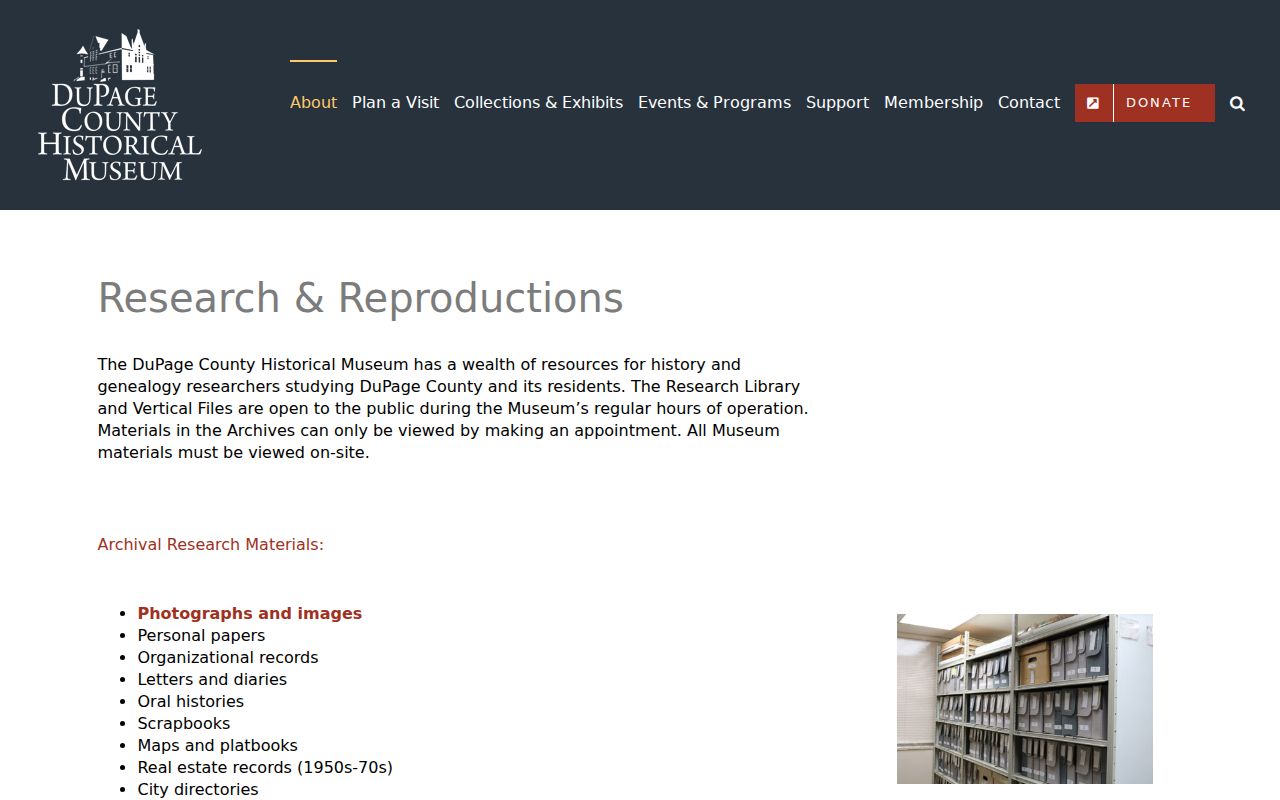
The museum capture below shows the institutional research route assigned to DuPage County previous residents work.
Use those holdings after recording the parcel, subdivision, old owner names, and likely dates. A narrow request for a plat, address, builder, or family surname is more useful than asking staff for everything about a house.
Wheaton Public Library complements the museum rather than duplicating it. Its genealogy specialist works with directories, suburban telephone microfilm, yearbooks, vertical files, cemetery indexes, and census resources. Send the exact house number, possible old street form, surname, and year range. If the house sits outside Wheaton, ask whether the relevant volume includes that municipality before treating silence as evidence.
DuPage Homes on Sanborn Maps
Fire-insurance maps date structures and street patterns rather than occupants. The Library of Congress Wheaton map set includes 1924 sheets; the research also identifies Wheaton 1898, Naperville 1892, and Downers Grove 1909 and 1927 sets. A sheet can show a building footprint, construction material, use, additions, and nearby street names.
Compare a map sheet with a directory year and a deed description. If the address is absent but the lot and street are present, the building may not yet have existed. If the footprint changes, permit, newspaper, or museum files may date the work. Sanborn coverage is municipal and partial, so a missing sheet does not prove a missing house.
Old DuPage Place Names
Museum history preserves names such as Cloverdale, Fullersburg, Eola, and York Center. These former settlements can appear in deeds, directories, cemetery references, and maps even when a current municipal dropdown does not list them. Search the old name with its township, then bridge back to the parcel through a legal description or plat.
Official county histories also disagree on whether DuPage was organized on February 9 or February 28, 1839. Keep the date and source together rather than flattening the conflict. That small discrepancy is a good model for address history: preserve what each record actually says.
DuPage Past Household Records
Owners are only half the story. Wheaton Public Library holds county and city directories, telephone books from 1951 through 2016, suburban telephone microfilm from 1920 through 1971, and Haines reverse directories. Those books can place a listed person at an address between census years. The full collection runs belong on the DuPage County city directory page; here, each volume acts as one dated rung in the address trail.
Pair the sources in sequence: check the nearest directory year, compare the nearest public census schedule, then return to the next directory. Federal census access follows the 72-year rule, and local holdings are uneven. Wheaton Library documents selected federal and state schedules, not a seamless annual run. Census boundaries and township labels may also differ from the modern parcel.
- Transcribe the directory entry exactly, including spouse, occupation, phone, and address abbreviations.
- Locate the street or enumeration district in the closest public census year.
- Compare household names and ages, but keep similarly named families separate until the address agrees.
- Check the next directory year to learn whether the household remained, moved, or disappeared from print.
- Use obituary, cemetery, newspaper, or probate sources to explain the endpoint.
The Wheaton Vital Records Index covers newspaper birth, marriage, and death notices from 1889 through 1893 and points to page, column, and microfilm. Obituaries may name relatives or former communities. A probate docket can explain an estate transfer, though DuPage research found no complete countywide public probate-name portal. Use Circuit Clerk access or a focused request.
Lawful use. Research DuPage County previous residents for house history, genealogy, or personal curiosity. Illinois stalking and cyberstalking laws prohibit using records to monitor, threaten, or harass a living person.