
DuPage Neighbors by Source
Official records describe land, filings, and public activity. They do not certify who is inside every home. The parcel map defines the immediate block. The assessor identifies a legal owner and dated situs. The Recorder verifies transfers and liens. Printed reverse directories can supply an older address-to-name lead, while municipal pages show public boards, events, permits, and community programs.
| Source | What It Shows About a Block | Access |
|---|---|---|
| DuPage Parcel Viewer | Boundaries, adjacent parcels, roads, districts, imagery and map context | Public viewer; 1,000-parcel selection cap |
| Assessor parcel card | Owner, situs, tax year, sales and taxing bodies | Parcel-by-parcel portal with date disclaimer |
| Recorder index | Deed, lien and transfer activity by address or PIN | Online by stated cutoffs; older office research |
| Voter lookup | Match-specific precinct, polling and district data | No casual block roster; Illinois law controls use |
| Haines criss-cross books | Historical address-to-occupant or phone lead | Wheaton Library print runs |
| Municipal civic pages | Boards, public meetings, events and permit clues | No complete member directory |
Call a result an adjacent parcel until another source supports more. A tax mailing address can be far from the situs, and an entity may own a common tract. Even an owner name does not establish present occupancy. Dating every result prevents an old transfer or directory entry from being mistaken for today's DuPage County neighbors.
One DuPage Parcel in Context
The Hedgerow Drive parcel card demonstrates what the assessor layer can reveal around neighbors without claiming occupancy.
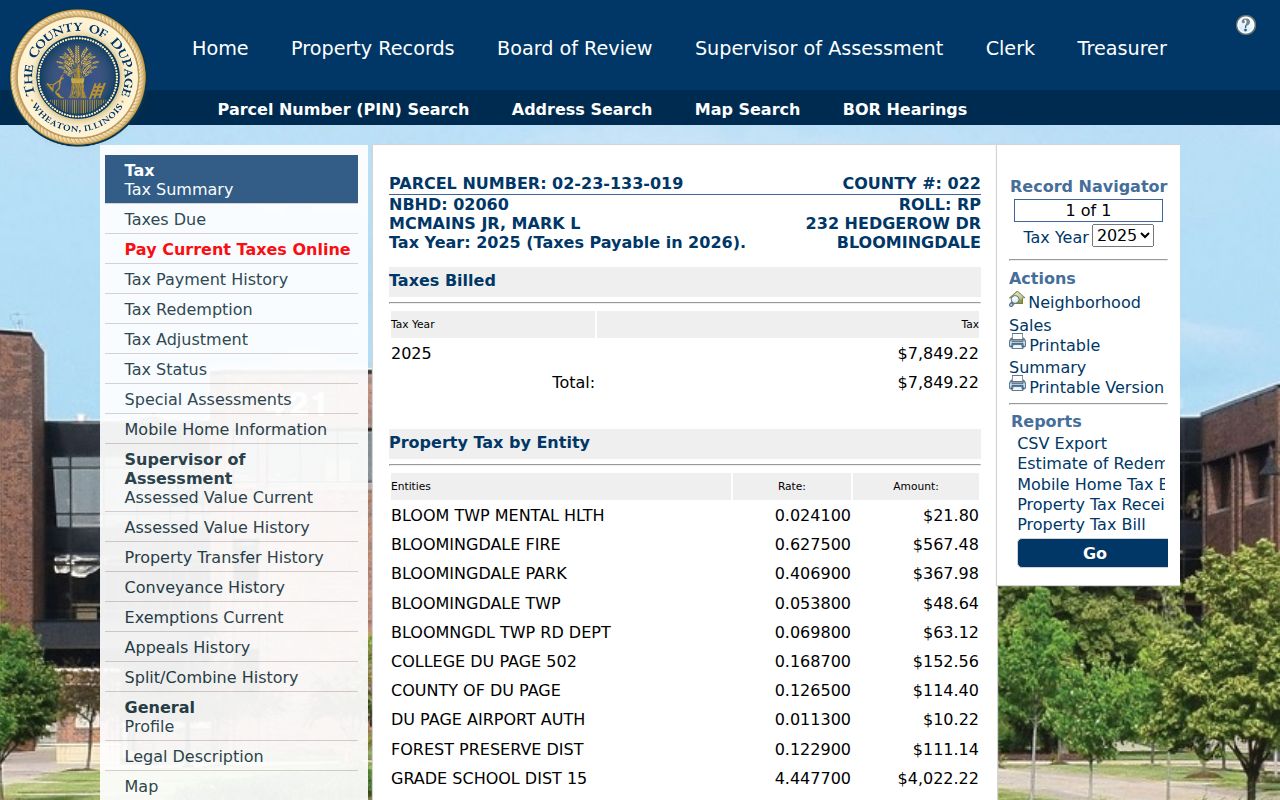
Its card shows a PIN, owner, situs, tax year, and many taxing bodies, including county, township, school, library, park, fire, forest preserve, and airport entities. Those districts identify public bodies that may hold permits, meetings, service, or assessment records tied to the location.
The physical address and tax mailing address remain distinct. Record both, but never use the mailing field alone to label someone a resident. A condominium common area, school, church, park, or utility parcel may have no household owner at all.
Map a DuPage Neighbor Block
The DuPage County Parcel Viewer supports address, PIN, intersection, subdivision, and advanced-address searches. Once the target parcel is selected, click each adjoining parcel separately or use a 250-foot buffer for a consistent immediate-area pass. The viewer also supplies layers, shape selection, print, and export tools.
- Search the starting address or PIN and select the correct parcel boundary.
- Zoom to the block, then click adjoining lots and record each PIN separately.
- Use a 250-foot buffer or draw a block face, staying below the selection cap.
- Open each PIN in the assessor portal and retain owner, situs, tax year, mailing address, and sales fields.
- Check Recorder transfers, then date and label the exported table or printed map.
This creates the flow: address to map, map to nearby PINs, PINs to parcel cards, then parcel cards to recorded deeds. It is a bounded block view, not a mass download. For a whole named road, use the DuPage County street directory.
Choose the map extent before exporting. A narrow radius answers which parcels touch the target. A drawn line can follow one block face, and a polygon can handle an irregular cul-de-sac. Keep the source selector, buffer distance, and search date with the file. Without those notes, another reader cannot tell whether a corner parcel was intentionally excluded or simply missed. Layers for roads, districts, imagery, flood areas, and wetlands add land context, but none names a household.
Intersections and subdivisions are useful when an address fails. Partial street text may also catch a spelling variation. Once a candidate appears, confirm the full PIN in the map popup and on the assessor card. This extra check matters near municipal edges and in Naperville, where the postal city can remain the same while the county changes.
DuPage Block Sales Records
The assessor's Neighborhood Search and Neighborhood Sales actions can reveal comparison parcels, while individual sales cards list dates, prices, document types, document numbers, grantors, and grantees. Follow the number into the DuPage Recorder index to verify the instrument. A deed proves a transfer interest, not that every named party moved onto or away from the block.
Keep each parcel's legal description with the sales row. Subdivision lots, annexation plats, easements, common areas, and parcel splits can make nearby land look simpler on the map than it is in the index. Recent Recorder address searches begin in 1995, PIN searching in 1985, and name/image indexing in 1961. Earlier records require party names, plats, or office research.
Note: Save DuPage County parcel and Recorder results with the search date because tax years, owners, and document availability change.
DuPage Neighbors in Civic Records
No authoritative countywide HOA, block-watch, congregation, or civic-club membership directory was found. Public sources offer narrower clues through events, board appointments, meetings, agenda packets, and permit reports. These show a dated public role, not everyone who belongs to a neighborhood.
| Local source | Public clue | Limit |
|---|---|---|
| Wheaton Community Relations Commission | Neighborhood events and block-party activity | No household roster |
| Naperville boards and commissions | Appointments, meetings and civic service | Not an association directory |
| Naperville permit reports | Addressed block parties and group labels | Event lead only |
| Downers Grove council material | Public references such as Orchard Brook HOA | Context, not membership |
Use the official contact or clerk for a current record. An agenda name may be stale, and a block-party applicant may be a coordinator rather than a resident of every nearby parcel.
Municipal custody also varies. Wheaton building records, Naperville permit reports, county Building and Zoning files, and Health Department inspections may all be keyed to an address, yet each answers a different question. If a public portal does not expose the record, Illinois FOIA permits a focused request to the correct public body. State the street address or PIN, date range, record type, and preferred electronic format. DuPage County ordinarily responds to a noncommercial request within five business days, subject to a statutory extension.
A civic reference should stay in its original setting. A board member's name shows an appointment. An association name on a permit shows an event label. A council biography mentioning an HOA shows one declared connection. None supports expanding the claim into a roster of DuPage County neighbors.
Wheaton Neighbor Connections
The Wheaton Community Relations Commission is an official route to neighborhood programming rather than a private roster.
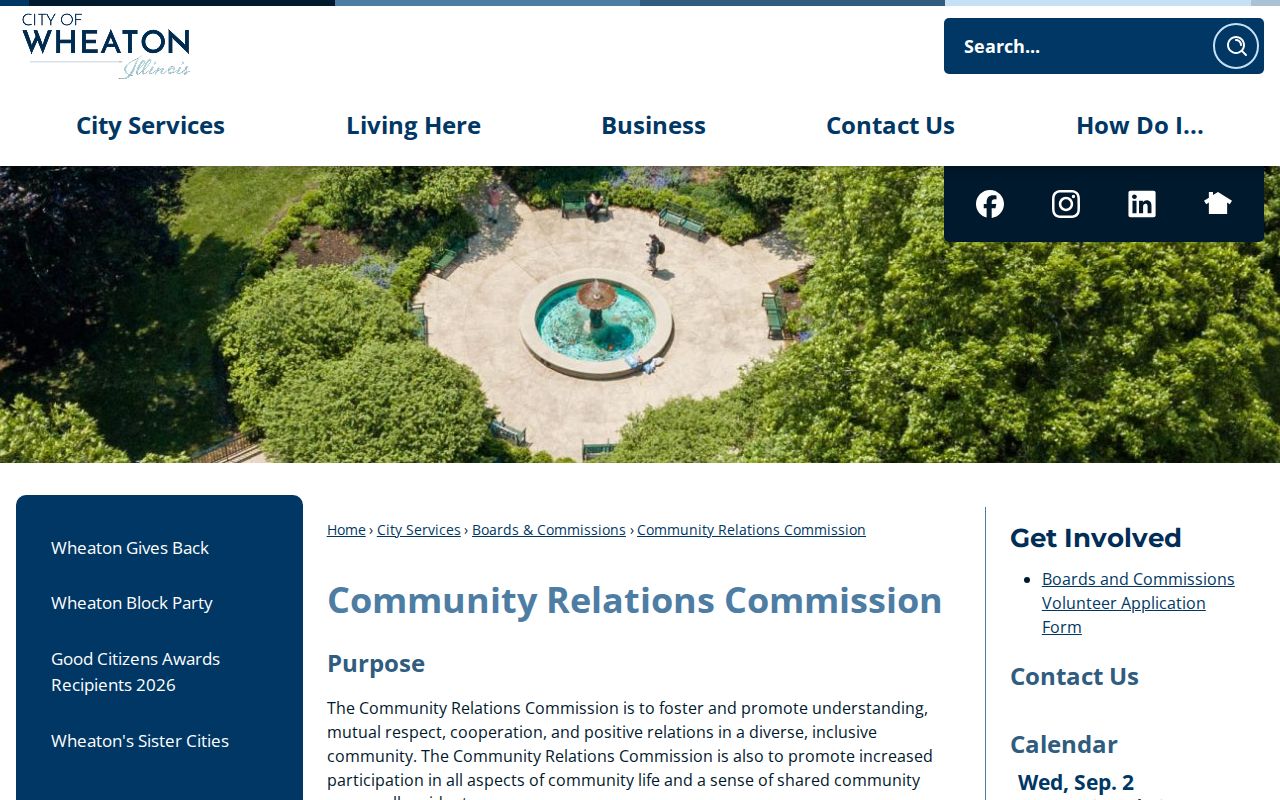
Public meeting and event information can identify a community channel, but it does not disclose unnamed household members. Contact the commission or city clerk for the specific public record and date needed.
Naperville Neighbor Civic Clues
Naperville boards and commissions publish civic-service routes and meeting records.
A listed appointment supports a dated public affiliation. It does not prove a home address. Naperville crosses DuPage and Will Counties near the 87th Street area, so verify the parcel county before choosing an office.
The county line changes the correct assessor, recorder, court, and local vital-record path. Postal names and ZIP codes were designed for mail delivery, not records jurisdiction. Start with parcel geography, then use the government body identified by that parcel rather than relying on the city written in a mailing address.
Verify DuPage Neighbor Profiles
Commercial neighbor tools compile property, directory, marketing, and public-filing data. Their speed comes with uncertainty about dates, source meaning, and merged identities. Official sources take more steps but preserve the custodian and context.
| Method | Strength | Main caution |
|---|---|---|
| GIS plus assessor | Exact parcel, PIN, dated owner and situs | Ownership is not occupancy |
| Recorder and civic records | Document numbers, transfers and public roles | A filing is not a household roster |
| Compiled profile | Fast cross-source lead | May merge stale or wrong people |
For DuPage County neighbors, confirm a parcel or public role at the original source rather than copying a broad profile.
Historical questions need a different official chain. Wheaton Public Library holds Haines criss-cross directories, telephone books, city directories, yearbooks, and local-history files. A reverse directory begins with an address and returns the published name or telephone listing for that edition. It can show past neighbors on a block, but an omitted or unlisted household remains possible. Cite the title and year, then compare the result with a census, deed, obituary, or newspaper notice instead of projecting it forward.
DuPage Neighbor Privacy Limits
Public block research does not reveal unnamed household members, guests, unlisted phones, utility accounts, or DMV addresses. Court matters may be sealed, impounded, expunged, or restricted. Vital certificates require eligibility. The Illinois Address Confidentiality Program gives eligible safety-risk survivors a substitute address and mail forwarding. It does not erase older deeds, newspapers, or directories.
Illinois voter registration cards have inspection and use limits under 10 ILCS 5/5-7. The county lookup returns match-specific precinct, polling, ballot, district, and representative information; it is not a downloadable neighbor list. Never try to work around protected-voter safeguards.
The Illinois Address Confidentiality Program serves eligible survivors of domestic violence, sexual assault, human trafficking, and stalking. Participants can receive a substitute address and mail forwarding for covered dealings with public agencies. Enrollment does not make all old public records vanish, but that is never a reason to reconstruct a protected location from scattered sources. Stop at the safeguard and direct correction or disclosure questions to the responsible agency.
Use as little personal detail as the task requires. A parcel PIN, dated map, permit number, or meeting citation is usually enough to verify a block fact. Avoid republishing birth dates, signatures, financial identifiers, relatives, or private contact details. If a source appears wrong, ask the custodian about its correction or redaction process rather than spreading the error.
Public access also has a practical fallback chain. If the GIS viewer is unavailable, use the assessor's address or map search and ask the county GIS office about a dated parcel export. When the assessor portal is in maintenance, retain the exact address and PIN for staff verification. Recorder staff can help with certified copies and older books. Municipal clerks handle their own permits and meeting files, while county departments answer requests for county-held records. This routing keeps a neighbor question with the office that created the record.
Corrections belong at that same source. A wrong owner name goes to the parcel or deed custodian, a mistaken meeting listing goes to the municipal clerk, and an old directory entry remains a historical publication rather than a live profile. Commercial removal does not alter the underlying public record. Keeping source, date, and record type together is the safest way to avoid turning a valid clue into a false claim about current DuPage County neighbors.
Lawful use. Look up DuPage County neighbors only for lawful civic, property, historical, or personal purposes. Illinois stalking and cyberstalking laws prohibit using records to watch, threaten, or harass anyone.