
DuPage County City Directory Shelves
Wheaton Public Library is the central DuPage County city directory source. Its local-history collection combines printed county and city books, Haines reverse volumes, telephone books, school annuals, census material, newspaper microfilm, and licensed genealogy databases. Some books can be read online. Others require a visit or an appointment with the genealogy specialist.
| Collection | Years | Where Held | Access |
|---|---|---|---|
| Bumstead's Wheaton and DuPage directory | 1915-16 | Wheaton Library / Internet Archive | Free digital scan |
| DuPage County directories | 1924-25 and 1925-26 | Wheaton Library / IDA Illinois | Print and digital |
| Wheaton city directories | 1940 and 1950 | Wheaton Library local history | Print, in person |
| Wheaton-Warrenville Polk | 1999 | Wheaton Library local history | Print, in person |
| West Suburban Haines | 1988-2021 | Wheaton Library local history | Print reverse lookup |
| Near West Suburban Haines | 2004-2021 | Wheaton Library local history | Print, scope varies by year |
| Wheaton telephone books | 1951-2016 | Wheaton Library | Print or microfilm |
| Chicago suburban telephone film | 1920-1971 | Wheaton Library | Microfilm |
The runs are not annual. A blank year is a publication or collection gap, not proof that a household left DuPage County. Check neighboring years, the scope statement, and alternate initials before drawing a conclusion.
Bumstead's DuPage County Directory Snapshot
The 1915-16 Bumstead's Directory is the earliest inspected printed directory in the local research set. Its coverage reaches Wheaton and towns or settlements including Addison, Bensenville, Bloomingdale, Downers Grove, Elmhurst, Eola, Glen Ellyn, Hinsdale, Lisle, Lombard, Naperville, Warrenville, West Chicago, Winfield, and rural routes. That list describes a publisher's geography, not a modern legal boundary.
The source scan can be viewed at the Internet Archive.
The title and pages preserve the edition context needed to cite an entry and test whether the publisher covered the town or rural route at issue.
A Bumstead line can compress a name, spouse, trade or firm, residence marker, street, and telephone into a few words. Read the key before expanding abbreviations. A phone number is a historical clue only and should never be treated as current contact information.
Read a DuPage County Directory Line
An inspected Bumstead entry reads, in substance, as a person's name followed by a spouse in parentheses, a trade or firm, the letter “r,” a street address, and sometimes a telephone. One example lists Brown L C with Evelyna, watchmaker, at 131 Front with phone 102. Another lists Burckal M J with Mame, “elect,” at 210 E Wesley. These are source examples, not present-day listings.
| Printed name | Surname, initials, or shortened first name as the publisher set it |
|---|---|
| Parentheses | Spouse or another stated household relationship |
| Trade or firm | The line's stated occupation or affiliation for that edition |
| Residence marker | “r” before the address means residence in the Bumstead key |
| Street and phone | Published house number, street form, and historical telephone when supplied |
- Criss-cross directory
- A reverse book arranged by street address, often with a name or phone beside the house number.
- Householder index
- An alphabetical or address-based list of the household names selected by the publisher.
- Abbreviation key
- The volume's own legend for marks such as “r,” initials, trades, and street forms.
Do not add facts the line does not state. An entry may omit a spouse, child, boarder, or person who chose not to list. Compare spelling variants, initials, nearby addresses, and the next available edition.
Wheaton's DuPage County Directory Room
The Wheaton Public Library local-history room is at 225 N. Cross Street in Wheaton and can be reached at 630-668-1374. The genealogy specialist accepts appointment requests at genealogy@wheatonlibrary.org. Ask for the exact city directory title and year, plus telephone film, census schedules, a yearbook, or a newspaper reel that can test the same identity.
The collection includes DuPage federal census print for 1840 through 1870, several federal and state microfilm runs, cemetery indexes, vertical files, and local histories. Licensed resources may require a library computer or card, so confirm access before a trip. If a book is not online, staff help and a microfilm reader are real access channels, not second-best substitutes.
Reverse DuPage County City Directories
Haines criss-cross volumes turn the usual lookup around. Start with a street and number, then read the listed name for that publication year. Wheaton Library's West Suburban run covers 1988 through 2021, while the Near West Suburban run covers 2004 through 2021. Check the geographic scope printed in each volume because “suburban” does not mean every DuPage municipality.
Telephone books overlap much of that period and reach farther back. Most Wheaton phone books also include Glen Ellyn, Warrenville, West Chicago, and Winfield. Yet an unlisted number, a shared phone, or a publication gap can hide a household. For today's parcel-centered method, move to the DuPage County street directory rather than forcing an old reverse book to answer a current question.
DuPage Names in Old Notices
The Wheaton Vital Records Index covers Wheaton Illinoian birth, marriage, and death notices from 1889 through 1893. Quick Search scans all fields. Advanced options include Name, Text, Event, Place and Date, Length, Notes, and newspaper page and column. A result can point to an abstract or an entire announcement, with the full paper available on microfilm.
The official index interface is shown at its linked source.
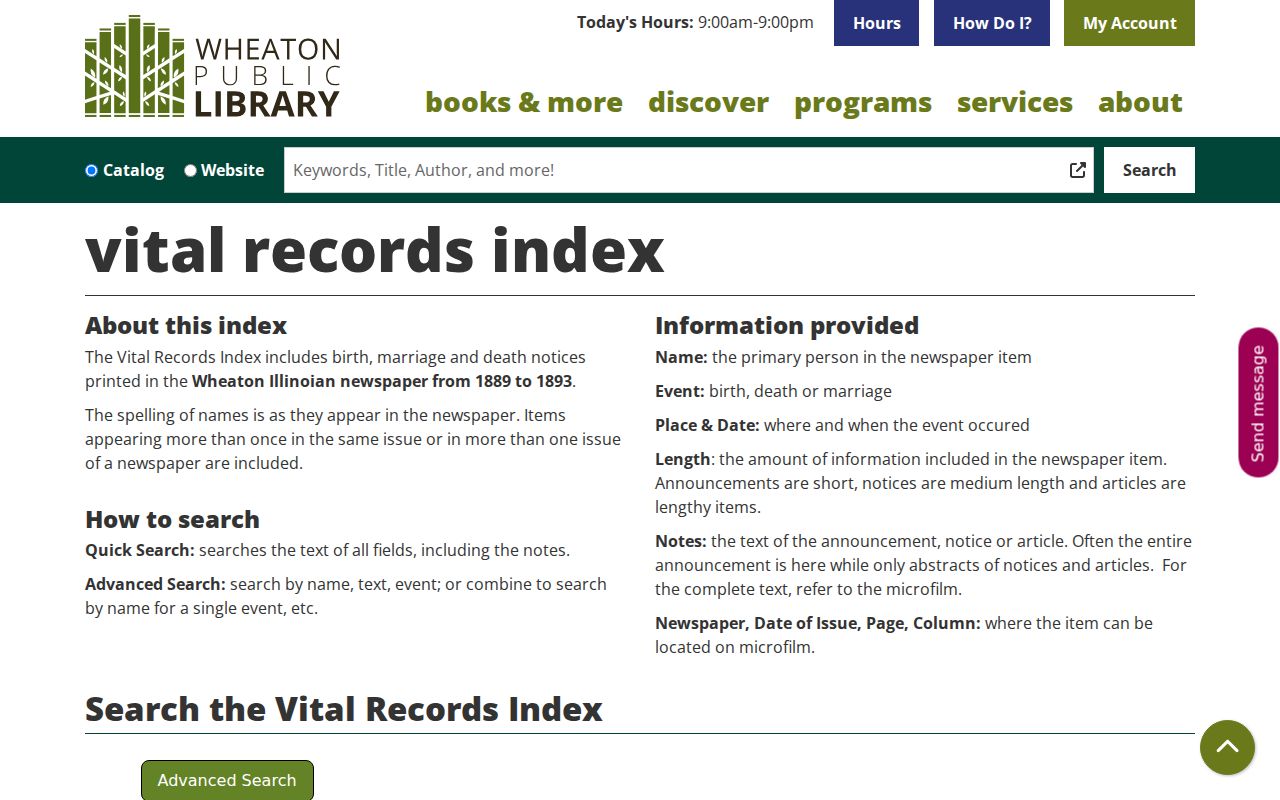
This narrow database can turn a city directory name into relatives, a place, an event date, and a precise reel target. It remains a newspaper finding aid, not a certified vital record.
Naperville's DuPage County History Shelf
Naperville Public Library Genealogy and Local History gives the county a second municipal research path. Naperville Digital Heritage contains more than 300 digitized books and images. The service also offers Heritage Film, Clarion and Sentinel newspaper images, genealogy appointments, and Fox Valley Genealogical Society volunteer help.
The genealogy and local-history landing page is captured from the library source.
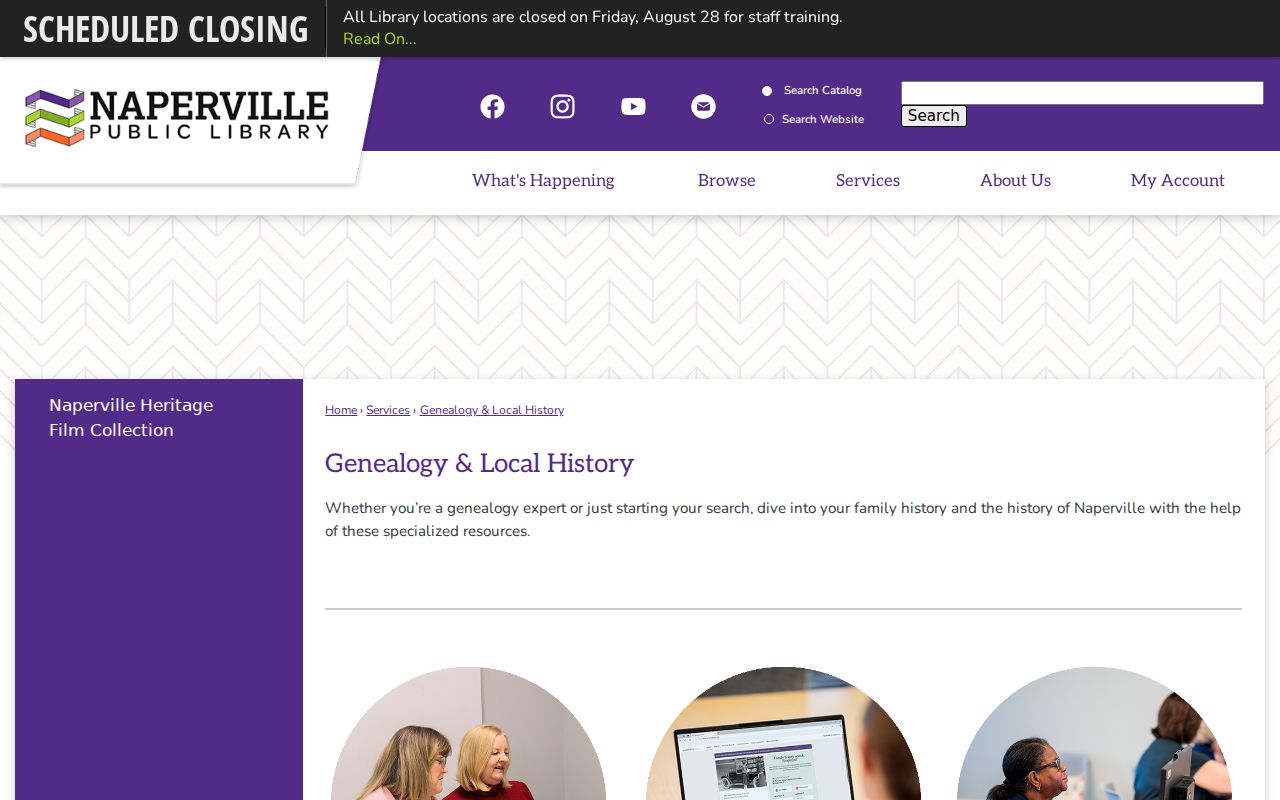
Naperville sources are useful when a person does not appear in a Wheaton-centered volume. First confirm whether the historical address lay in DuPage or Will County, since the city spans both.
DuPage County Yearbooks Fill Gaps
School annuals can test a former classmate or family link when a city directory omits younger household members. Wheaton Community High School volumes include 1909, 1911, 1913-15, 1918, and 1921-64. Wheaton Central runs cover 1965-71, 1973-85, and 1987-91. Wheaton North volumes cover 1965-72, 1974-2019.
A yearbook may add clubs, teams, faculty, or a class year, but it is a school publication, not proof of a later address. Ask the specialist for the exact school and edition. Then compare the surname, initials, spouse or parent, and town against a directory or newspaper source.
DuPage County Directory Maps and Archives
The DuPage County Historical Museum research library, at 102 E. Wesley Street in Wheaton, adds city directories, county histories, maps, platbooks, photographs, vertical files, land-sales material, and 1950s-70s real-estate records. Research Library and Vertical Files are available during museum hours. Archives are onsite by appointment.
Sanborn fire-insurance sheets give structure and street context but not a full occupant list. The Library of Congress has Wheaton sets from 1898 and 1924, Naperville from 1892, and Downers Grove from 1909 and 1927. Compare a directory address with the right map year, then check plats if the street form changed.
Old settlement names are another bridge. Museum sources preserve Cloverdale, Fullersburg, Eola, and York Center. Search an old place name with its township and legal land description when a current municipal dropdown has no match.
DuPage Directory Access Eras
The local sequence is not a smooth annual run. It moves from an early countywide publisher snapshot to county books, Wheaton editions, phone books, reverse directories, and modern parcel systems. This timeline marks access points documented in the local collections rather than claiming each gap has a directory.
- 1915-16: Bumstead's Wheaton City and DuPage County directory is now available as a free scan.
- 1924-26: county directory editions survive in print and digital form.
- 1940 and 1950: Wheaton city directory volumes are held in the local-history collection.
- 1951-2016: Wheaton telephone books provide a long, uneven companion run.
- 1988-2021: West Suburban Haines volumes provide address-first reverse searching.
- 1999: the Wheaton-Warrenville Polk directory supplies another printed city pair.
Official sources disagree whether DuPage County was organized on February 9 or February 28, 1839. Keep the cited source with either date. The conflict is a useful reminder that even a clean timeline must preserve provenance.
Trace Family Through DuPage Directories
Begin with a full name, spouse, street, phone, or trade in the closest available DuPage County city directory. Copy the entry exactly. Then move one edition at a time and use census years as fixed household snapshots between the irregular books. This method can reveal a move or changed name, but absence alone proves nothing.
- Find the nearest edition and save the title page, year, page, printed name, address, spouse, trade, and phone.
- Search adjacent editions with initials, alternate spelling, spouse name, former town, and the old street form.
- Use a Haines volume for the address-first view, or telephone film when no city book exists.
- Pair the address with a released federal or state census schedule, while allowing for changed district and township lines.
- Test the trail with a deed, tax card, newspaper notice, obituary, yearbook, cemetery index, plat, or Sanborn sheet.
The National Archives 72-year rule controls public federal population schedules. Wheaton's documented local holdings include older federal and Illinois census material in print or microfilm. A census household adds relationships and ages that a short directory line may lack, but transcription and boundary errors call for a second source.
A disappearance may mean a move, death, changed surname, missed edition, unlisted phone, or coverage gap. Newspaper and cemetery indexes can test death. A deed can test a transfer. The library or museum can help when a volume, reel, or street name is unclear.