
Finding DuPage County Residents
Start with the kind of link you need to prove. The Supervisor of Assessments is strongest when an address or parcel is known. The Election Division can confirm registration details for an eligible self-lookup, while the Recorder connects a name or property to recorded deeds, liens, plats, and other instruments. A court party search, professional license, business filing, or historical directory may add a second, independent match. No one roll proves that every person in a household lives there now.
The DuPage County residents directory works best as a chain. Keep names, dates, addresses, parcel identification numbers, and record numbers in separate notes. A billing address is not always the property address. A deed party may have sold years ago. Naperville also crosses the DuPage and Will county line, so confirm the county before searching.
- Search the county property roll by owner, billing name, address, PIN, or map.
- Check the DuPage voter lookup through its permitted name or address path.
- Use the Recorder index to connect a party, parcel, and recorded document.
- Compare modern results with court, license, business, or unclaimed-property indexes when relevant.
- For an older household, use library directories, newspapers, census material, and museum files.
- Request a record from the right custodian when a portal lacks the needed file.
DuPage County Directory Offices
Three county offices form the core directory trail. The Recorder preserves documents that show parties and interests in land. The Supervisor of Assessments publishes parcel ownership, situs, billing information, sales, and taxing bodies. The Election Division manages the voter lookup and election records. They share a county, but not a database. Use the DuPage County street directory when the task is to work along an entire road by address.
Supervisor of Assessments
421 N. County Farm Road
Wheaton, IL 60187
630-407-6500
DuPage Property Roll Search
The DuPage address search turns a street location into a parcel card. Other entry paths accept a PIN, billing name, or map selection. Once a PIN opens, note the tax year because the system warns that data reflect the last certified date and can change. The parcel card can show the owner, situs address, taxing entities, sales, and links to tax information. It should be read as an ownership record, not a full household list.
| Search path | Use it when | Result to retain |
|---|---|---|
| Address | Street number and name are known | PIN, situs, owner, tax year |
| PIN | A parcel identifier appears on another record | Parcel card and tax links |
| Billing name | An owner's name is known | Matched parcels and billing entry |
| Map | Nearby parcels or a boundary are the goal | Selected parcel and surrounding geography |
The manifest capture of the official address form shows the county's direct route from an address to the assessment record.
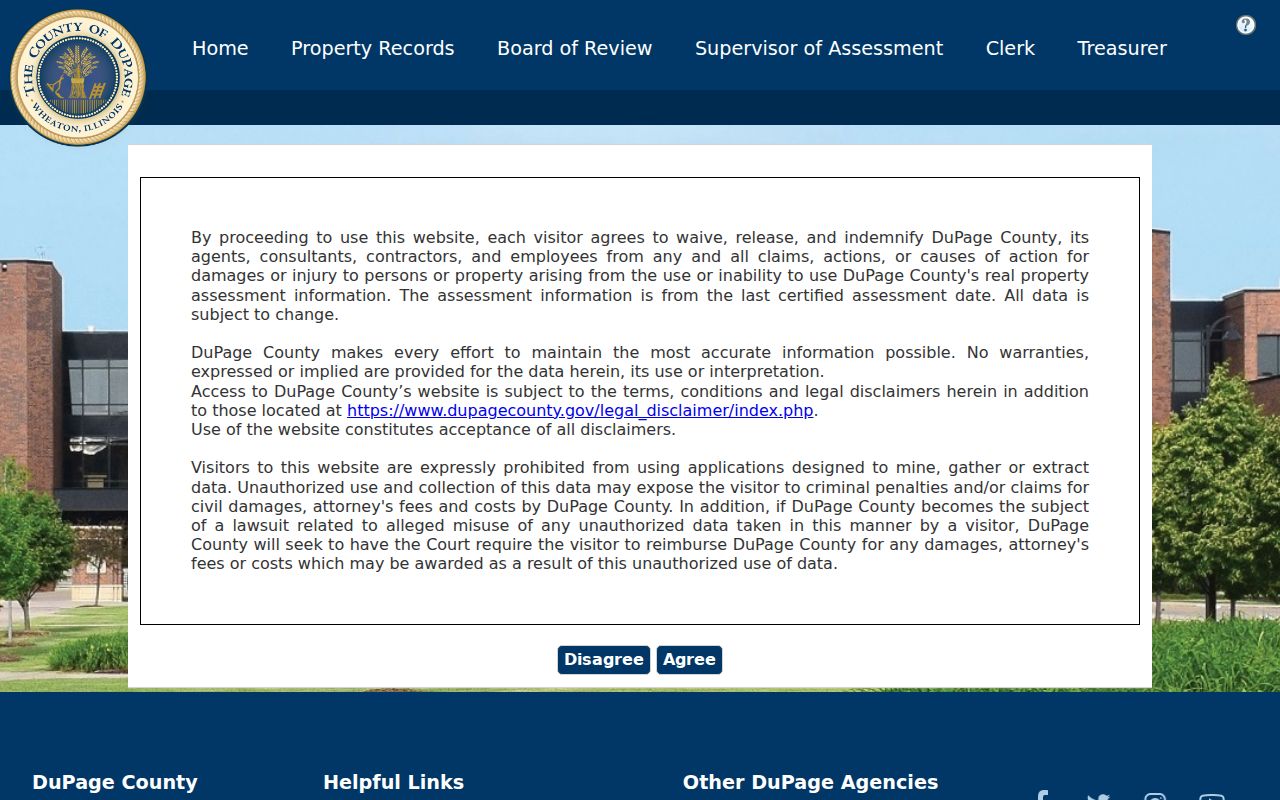
That form is the practical first stop when the street is known but the owner or PIN is not.
DuPage Recorder Name Index
The Recorder's Online Document Search accepts last and first name, bank, trust, subdivision or business, property fields, a four-part PIN, document number, document group, and date range. Its online public index and digital images begin March 16, 1961. PIN searching begins in 1985 and address searching in 1995, while records held in the office reach back to 1839. Older work therefore calls for the office books, a public terminal, or help from the research line.
The index is broader than deeds. Its groups cover mortgages and releases, plats, liens, judgments, easements, leases, powers of attorney, annexation instruments, UCC filings, and other recorded documents. Open a document number, inspect its details, and use the View/Print PDF path when an image is available. Certified copies and research assistance go through the Recorder.
The Recorder search capture illustrates how names, property fields, and document categories share one query screen.
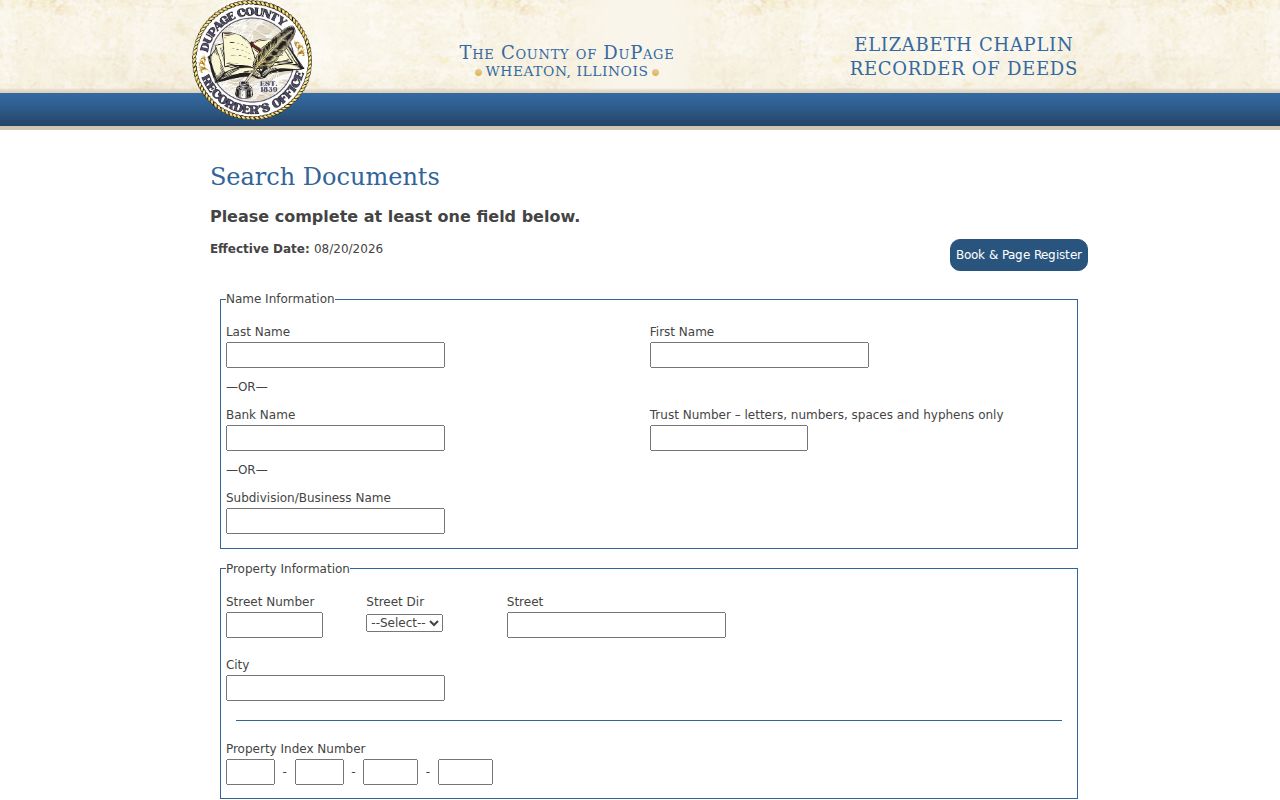
The range of fields helps distinguish a same-name match by parcel, city, date, and document type.
Current DuPage Resident Rolls
Modern directory evidence is split among records created for different public duties. The table shows what each source can support and, just as important, what it cannot. A match is a lead tied to that source's purpose. Compare it with a second official index before treating it as current.
| Resident source | People or parties shown | Official keeper | Public route |
|---|---|---|---|
| Property Records Search | Parcel owners and billing names | Supervisor of Assessments | Free interactive portal |
| Voter Lookup | Registered voter self-lookup details | Election Division | Name or address search with identity fields |
| Document index | Grantors, grantees, lien and instrument parties | Recorder of Deeds | Online index, office research, certified copies |
| Court case search | Named parties in public cases | DuPage Circuit Clerk | ePay search, courthouse terminals, request |
| Municipal records | Permit contacts, board members, licensees | City department or clerk | Posted files, department request, city FOIA |
Property files answer who owns a parcel, while election, court, and municipal records answer narrower questions. The one-name matching method is developed on the DuPage County resident lookup page.
DuPage Voter Directory Limits
The DuPage County voter lookup provides two routes. The name path asks for identifying details such as name, date of birth, and either the last four Social Security digits or an Illinois driver's-license value. The address path accepts street number, street name, direction, suffix, and city. Results can confirm registration status, precinct, polling place, sample ballot, districts, and representatives.
This tool is not a downloadable residents directory. Illinois election law regulates access to voter registration data, and protected personal fields are not ordinary public output. A voter-file request is a separate process through the Election Division. Use the county lookup for its stated election purpose, and do not treat absence as proof that a person has left DuPage County.
The official voter screen shows why a name search requires more than a surname.
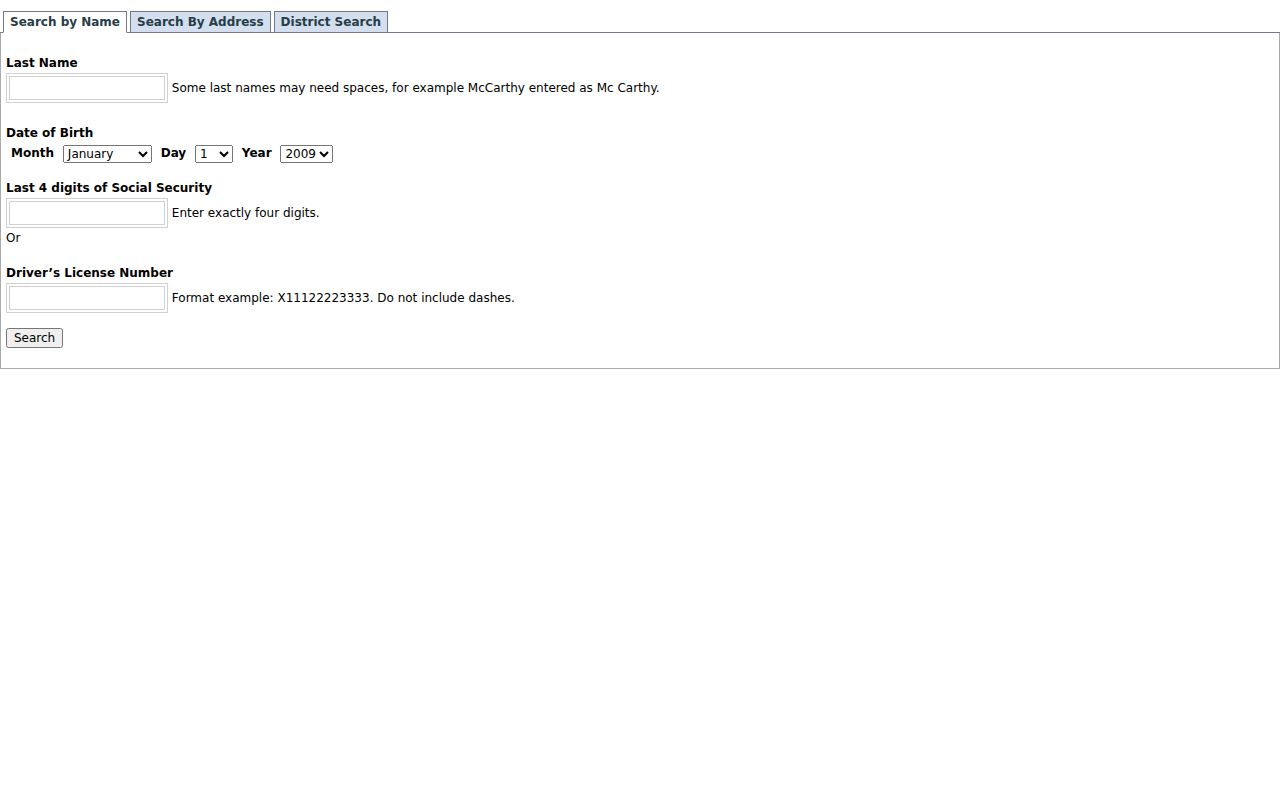
Those extra fields reduce false matches and keep the public result focused on registration and districts.
DuPage Court Name Records
The Eighteenth Judicial Circuit's public ePay case search offers complaint or agency, case number, and case-name paths. A person or organization search uses last, first, middle, and date-of-birth fields. Public case information can anchor a name to a case number, filing type, parties, docket events, and disposition, subject to the result screen and access rules. A docket is the court's event list for a case.
Web access is only one channel. Credentialed eAccess has separate terms, while courthouse public terminals can provide public files that do not behave like a simple open web search. Sealed, impounded, juvenile, expunged, and otherwise restricted records are excluded. Federal cases belong in PACER for the Northern District of Illinois, not the county index.
The Circuit Clerk search capture shows the distinct ticket, case-number, and case-name routes.
Choose the route that matches the identifier in hand, then verify the party against another official record.
Requesting DuPage Directory Records
Illinois FOIA, 5 ILCS 140, provides the fallback when a public county record is not posted. DuPage accepts requests by mail, fax, email, personal delivery, or a department form. No single county form is required. Describe the record, date range, person, address or PIN, preferred format, and contact details. Send it to the department that actually keeps the file, such as the Recorder, Election Division, Building and Zoning, GIS, Sheriff, or Supervisor of Assessments.
The general response period is five working days, with a qualifying five-day extension. Inspection is available. County instructions state that the first 50 black-and-white letter or legal pages are free, then cost $0.15 per page; color and unusual sizes may be charged at actual cost. A written denial should name the official responsible. Review can be sought from the Illinois Attorney General's Public Access Counselor.
Choose a direct service before FOIA when the office already has one. Recorder staff can help with document research and certified copies. The Assessor offers web, map, and office routes. Vital certificates use County Clerk or state forms with identity and eligibility checks. Wheaton also accepts city records requests online, in person, by mail, email, or fax. A focused request names the exact file and custodian, which is far more useful than asking an office to find every record about a person.
Naperville's Two-County Quirk
A Naperville mailing address does not always lead to DuPage County. The city spans DuPage and Will Counties, and its own township guidance places the DuPage portion generally north of 87th Street. Municipal, ZIP, township, and county lines also serve different purposes. Confirm the parcel PIN, county, and municipality before requesting a permit, court file, deed, or vital record.
This geography explains many failed searches. A portal may be working as designed while the record sits with a neighboring custodian. The county parcel and GIS tools can settle the jurisdiction question before a name is run through several unrelated systems.
The same caution applies inside DuPage County. Its 39 municipalities, nine townships, and unincorporated areas do not share one city-record system. Wheaton's clerk, for example, keeps council material, ordinances, permits, city licenses, boards, and local administrative files, but routes county vital records, elections, and circuit cases to other custodians. Naperville's permit system and issued-permit reports follow that city's own process. A municipal file can identify an applicant, owner, board member, license holder, or report party without proving where that person lives today.
Note: Keep the legal description and PIN when a city name, mailing ZIP, or street label changes across records.
Reading DuPage Record Terms
Public offices use compact terms because each index tracks a legal or administrative act, not a household. Define those terms before combining sources. A clear label prevents an owner, filer, or document party from being mistaken for a current resident.
- Parcel
- A mapped unit of land identified by a county PIN.
- Situs address
- The property's physical address, which can differ from the billing or mailing address.
- Index
- A searchable list pointing to a record; it is not the complete document or a certified copy.
- Grantor and grantee
- The party giving an interest and the party receiving it in a recorded instrument.
- Criss-cross directory
- A printed directory arranged by street and address instead of only by surname.
These distinctions are the backbone of a sound DuPage County residents directory search. Record the source, access date, tax year, and record number with each finding.
Historic DuPage Resident Directories
Wheaton Public Library is a central stop for earlier residents. Its local-history collection includes city directories, telephone books, yearbooks, newspapers on microfilm, genealogy databases, and staff help. The digitized 1915-1916 Bumstead's Directory of Wheaton City and DuPage County gives names, occupations, spouses, businesses, and addresses from an earlier era. Later reverse directories let a researcher begin with a street rather than a surname.
The DuPage County Historical Museum adds appointment-based research files, maps, real-estate material, photographs, newspapers, and vertical files. When no online index exists, contact the library or museum, describe the name, address, and date span, and ask staff which shelf or file series fits. The detailed year-by-year shelf guide belongs to the city directory section of the site.
Printed sources should be compared by year, not treated as a continuous roll. A person may be omitted between editions, an occupation may be shortened, and the same street may appear under an old form. Telephone books, yearbooks, newspaper notices, cemetery material, and census schedules can test a directory match. Wheaton Public Library's searchable index to Wheaton Illinoian birth, marriage, and death notices from 1889 through 1893 supplies a narrow but useful bridge from a name to the newspaper on microfilm.
The Wheaton library capture shows the local collection that bridges printed directories and modern digital sources.
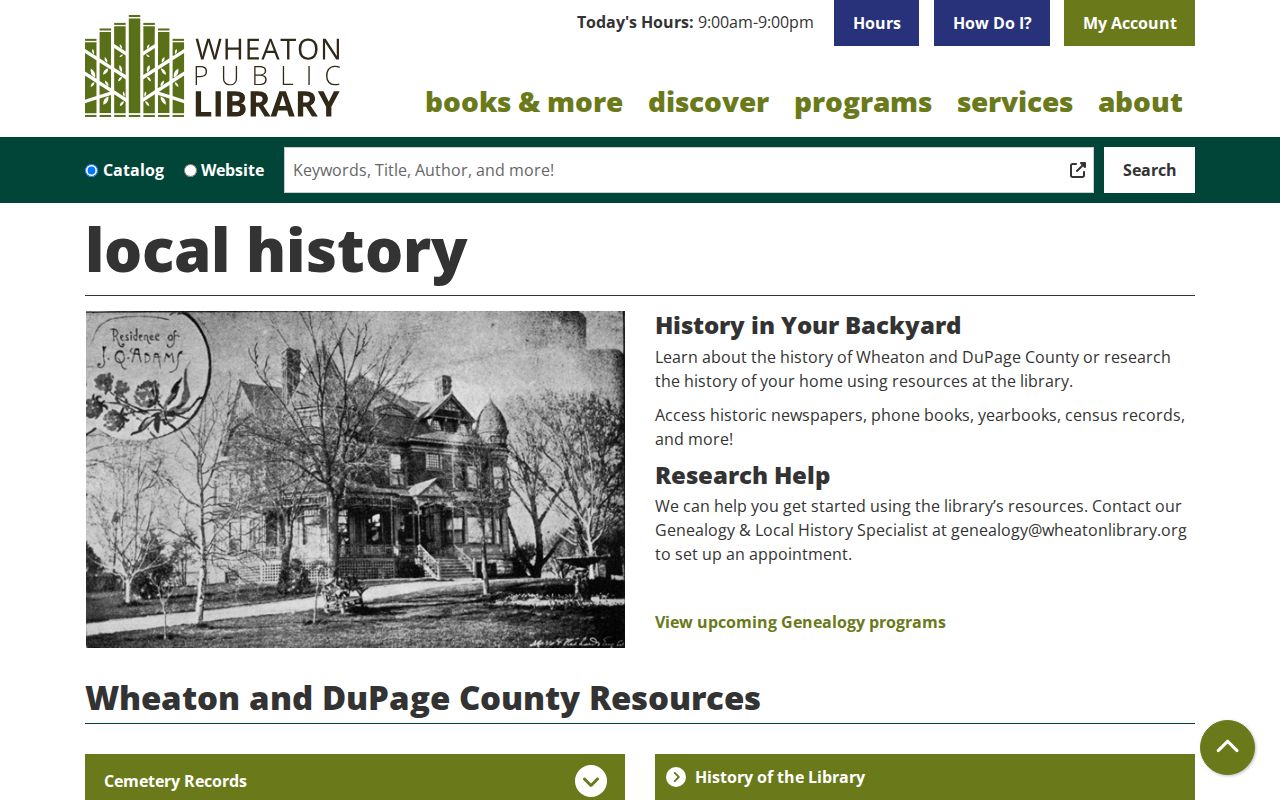
That mix of books, microfilm, and research help fills gaps left by current county portals.
Official Rolls Versus Search Sites
Official records and commercial search products answer different questions. County and state indexes disclose the custodian, fields, and legal purpose behind a result. Commercial products merge data from many sources and may lag behind corrections, address changes, or same-name distinctions. They can be convenient leads, but they do not replace the underlying deed, parcel card, docket, license, or directory image.
| Choice | Strength | Main limit |
|---|---|---|
| Official DuPage roll | Named custodian and defined record purpose | Usually covers one record system |
| Library or archive | Original historical volumes and local context | May require a visit, request, or staff help |
| Commercial search category | Broad lead gathering | Unknown update cycles and merged errors |
For a result that matters, return to the office or institution named on the source. Save a record number or stable citation so staff can reproduce the search.
Access method also affects what can be found. A free web index is quick, but older Recorder books require office research. Court terminals can expose public case material that is not packaged as an open download. A library shelf may hold the only address-arranged directory for a given year. County FOIA can obtain an existing record, but it does not require staff to answer a broad question or create a new resident list. Ask for a defined file, date range, address, PIN, or named record series.